Filter Review · April 17, 2026
Does ZeroWater remove microplastics?
ZeroWater markets its 5-stage filter as the most aggressive pitcher on the market. It is — against dissolved solids. A ZeroWater pitcher will drop the TDS (total dissolved solids) reading on the included meter to essentially zero, which is why it's called ZeroWater. But microplastics aren't dissolved solids. They're suspended particles. That's a different filtration problem.
What the 5 stages actually do
- Stage 1: Coarse filter screen. Physical sediment block.
- Stage 2: Foam distributor. Even flow across the filter.
- Stage 3: Multi-layer activated carbon. Chlorine, taste, some organic contaminants.
- Stage 4: Dual ion-exchange resin bed. The big one — strips dissolved solids (calcium, magnesium, some lead, chromium) via ion exchange.
- Stage 5: Non-woven membrane + ultra-fine screen. Final particulate cleanup.
Stage 5 is what could physically trap microplastics. ZeroWater doesn't publish a pore size rating for it, and no independent NSF certification for microplastic removal exists on ZeroWater pitchers as of 2026.
What ZeroWater is NSF certified for
NSF 42 (chlorine taste/odor), NSF 53 (lead, chromium, PFOA/PFOS), and NSF 372 (low-lead materials). Not NSF 401 and not any microplastic-specific standard. The company's website mentions microplastic reduction but without a referenced NSF certification line.
The realistic expectation
A ZeroWater pitcher is probably better than a Brita at microplastic capture because of the denser resin bed and finer final screen. But “probably better than a Brita” is not “as good as RO.” An RO membrane has a pore size around 0.0001 µm. No pitcher filter gets remotely close to that.
If microplastics are your specific concern, RO is the right investment. If you're on a budget and want to reduce TDS and chlorine and probably some microplastics at a pitcher price, a ZeroWater will do more than a Brita.
Test your own pitcher
Stop guessing, run the test. The Water Test at-home kit is $50 for two tests. One on tap, one on ZeroWater output. The filter discs next to each other will tell you exactly how much particle reduction you're getting.
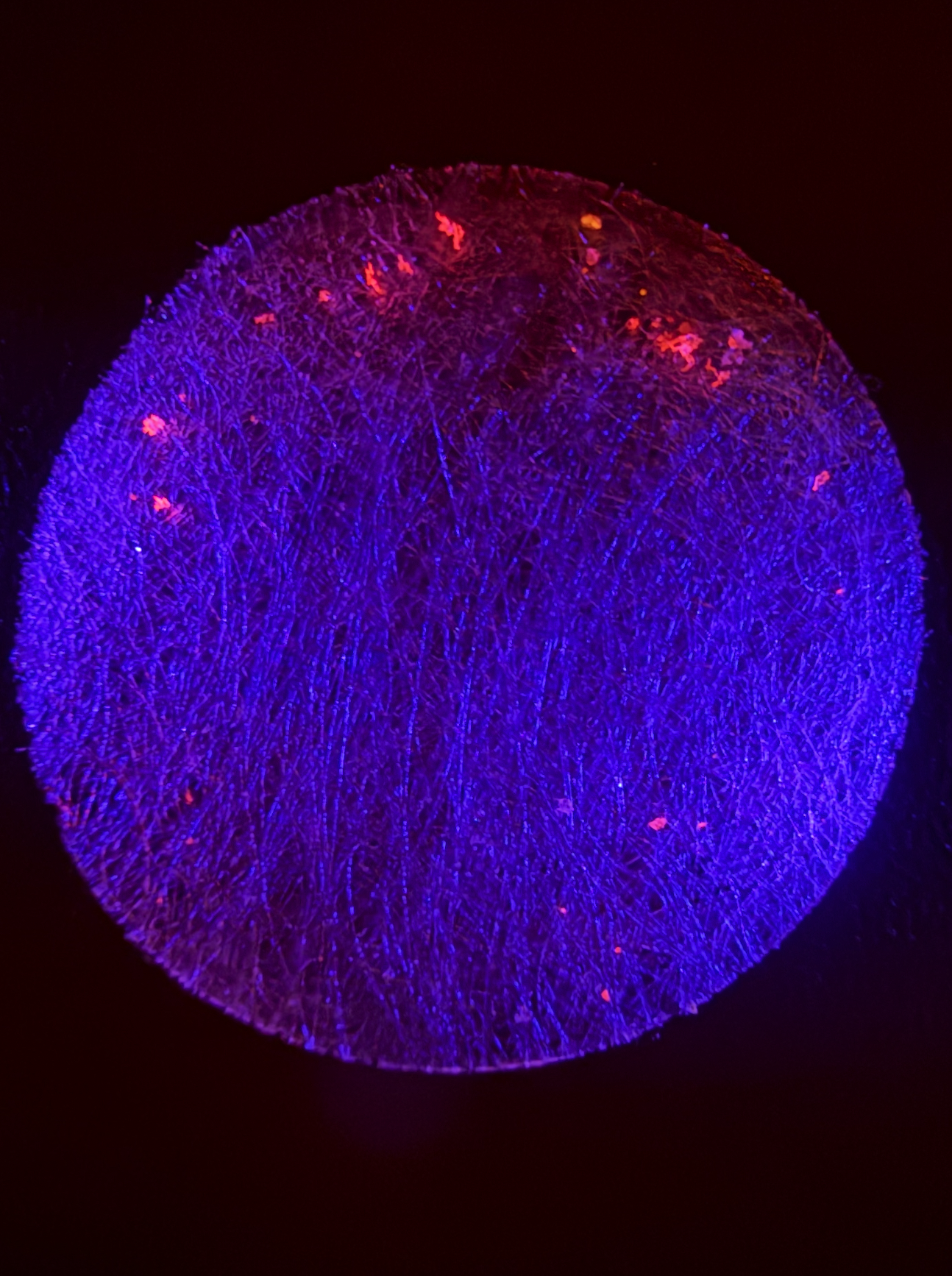
An at-home filter test result. Every pink dot is a piece of plastic the filter missed.
Related